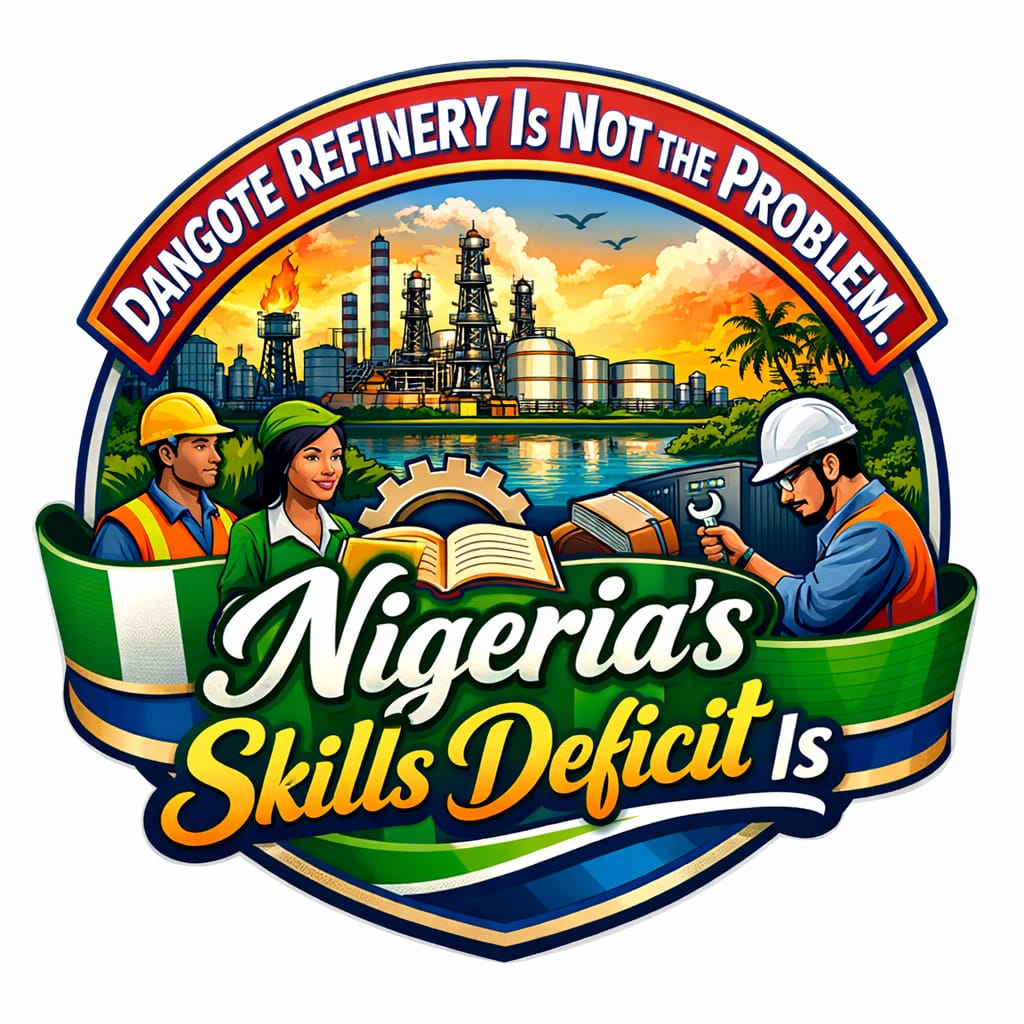
The controversy over foreign technicians at the Dangote Refinery has been widely misread. It is not a labour scandal, nor a betrayal of Nigerian workers. It is a mirror held up to a long-ignored truth: Nigeria has invested in assets but neglected skills. The refinery is already in Nigeria. The real question is whether it will become a Nigerian industrial school or remain merely a Nigerian-owned project operated with imported expertise.
That distinction matters more than outrage.
For decades, Nigeria has equated development with visible infrastructure roads, power plants, ports, refineries. Yet infrastructure without indigenous technical competence is incomplete. A refinery is not just steel and concrete; it is a complex system that demands process engineers, instrumentation technicians, control-room operators, corrosion experts, safety specialists, and maintenance professionals. Where these skills are scarce locally, capital must import them. This is not unique to Nigeria. What distinguishes countries that industrialised successfully is how deliberately they built technical capacity.
India offers a useful comparison, not a rivalry. Its advantage did not come from preference or privilege but from policy. Since the 1960s, India invested heavily in polytechnics and industrial training institutes aligned with real industry needs. By the time its economy opened up, it already had thousands of technicians ready to work at home or abroad. Nigeria, meanwhile, expanded universities rapidly while neglecting technical and vocational education, producing more certificates than competence.
The result is an uncomfortable paradox: even indigenous billionaires become dependent when human capital is weak. Ownership without operational mastery leads to reliance. Foreign technicians are not symbols of domination; they are evidence of absence absence of long-term investment in skills, apprenticeships, and industry-linked training.
The Dangote Refinery should therefore be treated not as an embarrassment but as an opportunity. Major industrial projects shape national capability only when they function as learning platforms. South Korea used its early shipyards and steel plants to train generations of engineers and technicians. Japan’s post-war factories became classrooms through structured learning-by-doing. Nigeria can do the same.
The refinery should be repositioned, through policy and partnership, as a national technical training hub. Every foreign technical role should have a Nigerian understudy. Skills transfer should be mandatory, structured, and measurable. Incentives and regulatory support should be tied to demonstrable competence, not token localisation.
At the same time, Nigeria must confront the cultural problem beneath the technical one. Society continues to glorify theoretical degrees while looking down on technical work, even though modern life depends entirely on it. Countries that industrialised restored dignity, income, and status to technical careers. Nigeria must do the same if it is serious about development. Development does not begin when we cut ribbons. It begins when we no longer need outsiders to run what we own.
The presence of foreign technicians at the Dangote Refinery is not a verdict on Nigeria’s worth. It is a diagnostic signal of where we failed to invest. If we respond with strategy rather than anger by rebuilding technical education, enforcing skills transfer, and treating industry as a classroom this moment will be remembered not as a scandal, but as the start of Nigeria’s technical reawakening. In the end, the true measure of development is not building the biggest refinery, but producing the people who can build the next one without help.