By Jude C. Anago
On the 4th of June, I attended the 5th Distinguished Public Lecture Series of Coal City University, Enugu, where Prof. Kingsley Chiedu Moghalu delivered a lecture on “Youth, Leadership and Nation-Building in Nigeria. Like many educational gatherings, the event featured insightful conversations about leadership, the future of Africa, and the role of higher education in national development.
Yet one conversation, I had with the Vice-Chancellor stayed with me long after the lecture series ended. During discussions with members of the university community, we explored a provocative question: What would it take for an African university to become the continent’s undisputed leader in simulation and sandbox-based education?
The more we discussed it, the clearer it became that this question extends far beyond one institution. It is a question that every vice-chancellor, university proprietor, policymaker, regulator, and lecturer across Africa should be asking.
The future of higher education may not be determined by who builds the largest lecture halls, acquires the most impressive buildings, or offers the greatest number of degree programmes. Instead, it may be determined by who creates the most effective learning environments for developing real-world capability. And that future belongs to simulation and sandbox learning.
For decades, universities have operated on a model that was highly successful for the industrial age. Professors taught. Students listened. Notes were taken. Examinations were written. Degrees were awarded. This model helped produce generations of professionals and leaders. But the world for which it was designed no longer exists.
Today, knowledge is abundant. Artificial intelligence can summarize textbooks, explain theories, and answer questions instantly. Information that once resided exclusively in libraries and lecture notes is now accessible on smartphones. The challenge facing universities is no longer access to information. The challenge is helping students develop the ability to apply knowledge under conditions of uncertainty.
Employers increasingly seek graduates who can solve problems, make decisions, collaborate across disciplines, communicate effectively, and adapt to rapidly changing circumstances. These competencies cannot be developed fully through lectures alone.
A student may memorize financial theories yet struggle to evaluate an investment opportunity. A business graduate may recite management frameworks yet find it difficult to lead a team. An engineering student may excel in examinations but hesitate when confronted with a real-world design problem. The gap between academic knowledge and practical capability remains one of the greatest challenges in higher education.
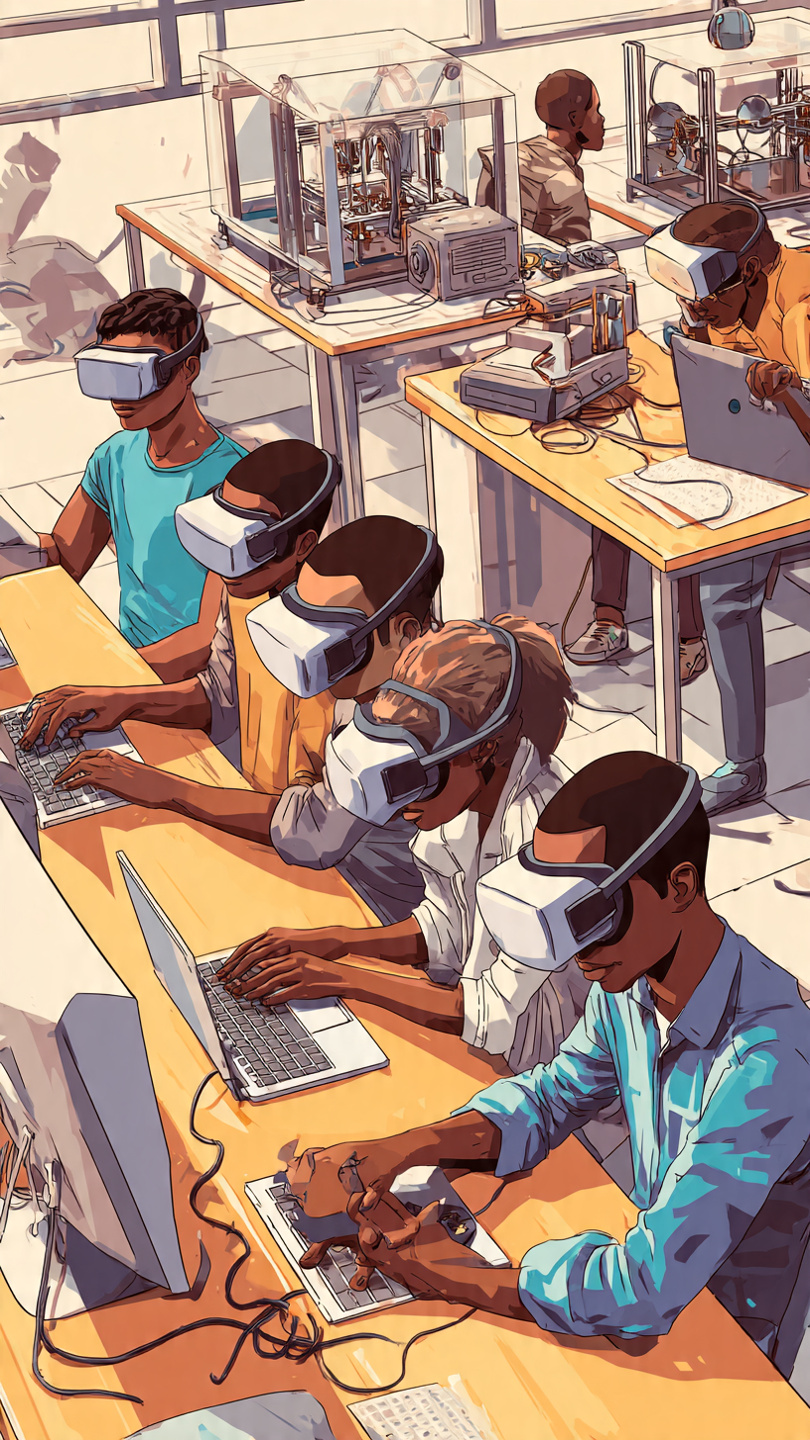
Simulation-based learning offers a powerful solution. A simulation is more than a classroom exercise. It is a structured environment that replicates aspects of the real world, allowing students to learn through action, experimentation, decision-making, and reflection. On the other hand, a sandbox is a safe space where learners can test ideas, make mistakes, receive feedback, and improve without suffering real-world consequences. Instead of merely studying reality, students practice reality.
Consider an investment banking class. Under the traditional model, students attend lectures on valuation techniques, mergers and acquisitions, capital markets, and financial modelling. They complete assignments and sit examinations.
Under a simulation model, students become investment bankers. Some act as corporate executives seeking financing. Others serve as merger advisers, private equity investors, regulators, credit-rating analysts, or institutional investors. They negotiate deals, value companies, respond to market shocks, defend recommendations, and experience the complexity of financial decision-making.
The difference is profound. One approach teaches students about investment banking. The other teaches them how to think like investment bankers. This distinction applies across disciplines. Medical students can diagnose virtual patients before entering hospitals. Engineering students can design and test infrastructure in digital environments before working on real projects. Law students can participate in mock negotiations, arbitration hearings, and courtroom simulations. Public policy students can manage simulated national crises, budget allocations, and diplomatic negotiations. Entrepreneurship students can launch and manage virtual ventures while confronting realistic market conditions.
In each case above, learning becomes active rather than passive. The student is transformed from a recipient of information into a participant in professional practice. This is particularly important for undergraduate education. Executive learners often bring years of workplace experience into the classroom. Undergraduate students typically do not.
Simulation environments can provide what many undergraduates lack: experience. A student who has never managed a budget can manage one in a simulation. A student who has never negotiated a contract can negotiate one in a sandbox. A student who has never presented to a board of directors can do so in a simulated corporate environment. These experiences build confidence, judgment, and competence long before graduation.
Some university leaders assume that simulation-based education is expensive and therefore reserved for elite universities. This is a misconception. The most effective simulations often require creativity more than technology. A lecturer can transform a classroom into a boardroom. Students can assume stakeholder roles and work through realistic scenarios. Role-play exercises, crisis simulations, negotiation workshops, mock trials, and policy games can be implemented with minimal resources. Technology expands possibilities, but it is not a prerequisite.
Universities can begin immediately. The larger opportunity lies in institutional ambition. Imagine an Nigerian university where every student participates in simulations throughout their degree programme. Imagine engineering students collaborating with business students to commercialise innovations. Imagine law students advising entrepreneurship teams. Imagine public health students responding to simulated disease outbreaks alongside data scientists and policymakers. Imagine artificial intelligence acting as customers, investors, regulators, patients, and competitors within a digital learning ecosystem.
Such a university would not merely teach knowledge. It would cultivate capability. And capability is increasingly the currency of the twenty-first-century economy.
For policymakers, the implications are equally significant. National quality assurance frameworks often emphasize curriculum content, staff qualifications, infrastructure, and accreditation requirements. These remain important. But the next generation of quality assurance should also evaluate experiential learning outcomes. How effectively are students applying knowledge? How frequently are they making decisions in realistic environments? How prepared are they to perform on their first day of employment? These questions deserve a central place in higher education policy.
Africa’s demographic future makes this conversation urgent. The continent possesses one of the youngest populations in the world. Millions of young people will pass through universities in the coming decades. The success of these students will depend not merely on what they know but on what they can do. Universities that continue to focus exclusively on information transfer risk becoming increasingly disconnected from labour market realities. Those that embrace simulation and sandbox learning will produce graduates who are better prepared for leadership, innovation, entrepreneurship, and professional practice.
My conversation at Coal City University ultimately led to a simple conclusion. The universities that will lead Africa in the coming decades may not be those with the largest campuses or the most impressive buildings. They may be those that create the most authentic learning experiences. The institutions that move from teaching theories to cultivating capability, from lectures to experiences, and from memorisation to decision-making will define the future of African higher education.
Simulation and sandbox learning are not educational trends. They are emerging as the architecture of a new university model. The question is no longer whether this transformation will happen. The question is which African universities will lead it.
Dr. Jude C. ANAGO is a Senior Lecturer with the university of Nigeria, Enugu Campus.