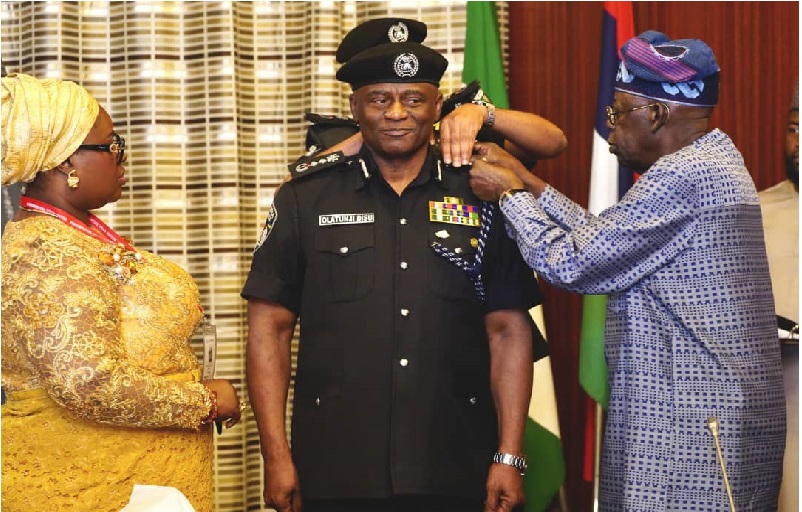
President Bola Tinubu, widely acknowledged for his keen political insight and talent for identifying skilled individuals for essential roles, maintained his reputation with the appointment of Assistant Inspector-General of Police (AIG) Olatunji Disu as the Acting Inspector-General of Police.
This decision followed the resignation of former IGP Kayode Egbetokun and demonstrated Tinubu’s commitment to choosing leaders with substantial experience for key assignments within the nation’s security apparatus.
The Presidency said Disu’s “operational depth” and leadership capacity were key considerations, adding that a Police Council meeting would be convened to consider his substantive appointment before transmission to the Senate for confirmation. State House
For a Force under intense public scrutiny—balancing rising security threats, reform pressures, and expectations of professionalism—Disu’s emergence reads like a deliberate pivot to an officer marketed by his supporters as a field-tested operator with an institutional reform streak.
Indeed, Disu parades a sound educational background with a deliberate blend of humanities, governance, criminology and enterprise. His academic path spans language and education, public administration, criminology, and entrepreneurship. This mix aligns with modern policing, which increasingly demands strategy, psychology, leadership, and stakeholder management alongside operations.
The making of an IGP: from peacekeeping to high-stakes policing
Disu’s career narrative is anchored on deployments where command discipline meets public-facing performance. He served across multiple operational and investigative roles, including leadership stints that placed him at the heart of anti-robbery and anti-kidnapping work, as well as strategic command responsibilities in major formations.
One of the defining early milestones is his role in 2005 as contingent commander leading the first-ever Nigerian Police contingent on the African Union Mission in Sudan (AMIS), deployed to help stabilise Darfur—an experience that burnished his credentials in crisis coordination and international security cooperation.
Back home, Disu became widely associated with the Lagos Rapid Response Squad (RRS), where he pushed a brand of tactical policing packaged with citizen-facing restraint—an approach his advocates described as “policing with a human face.” His RRS stint between 2021 to 2021 highlights his emphasis on engagement and de-escalation, alongside an effort to professionalise officer conduct and public communication.
A reform signal: “The Good Guys” branding and public trust politics
In Lagos, Disu’s RRS years were framed around rebranding and behavioural standards—popularly tagged “The Good Guys”—with supporters arguing it improved both response culture and public perception, particularly in a period when police legitimacy was a national flashpoint.
Pundits agree that with a sound education and diverse training, Disu’s background matters now because the IGP’s seat is no longer only about command; it is also about credibility. Disu inherits a moment shaped by institutional tension and public debate over leadership and accountability at the top of the Force.
Before his elevation, Disu served as AIG in charge of the Force Criminal Investigation Department (FCID) Annex, Alagbon, Lagos. He also previously served as Commissioner of Police in Rivers State and later as CP, Federal Capital Territory—roles that exposed him to urban crime pressures, political-security sensitivities, and complex inter-agency coordination.
Disu’s non-traditional public identity—competitive judo—has become part of his leadership mythos. In July 2022, he won a silver medal at the US Open Judo Championship (Veteran Division, -100kg), at a time he was Deputy Commissioner of Police and head of the Force Intelligence Response Team.
Professional affiliations and “soft power” credentials
Beyond operations, Disu holds membership of the Nigerian Institute of Public Relations (NIPR), the Chartered Institute of Personnel Management (CIPM), and the International Association of Chiefs of Police—signals of interest in stakeholder management, people systems, and global policing networks.
Disu’s appointment is being read as a bet on execution—intelligence-led policing, tighter investigative outcomes, and visible discipline—at a time when Nigerians demand security gains that are measurable and sustained.
His immediate challenge will be to convert a reputation built in specialised commands into Force-wide standards: professionalism at scale, accountability without paralysis, and public confidence without propaganda.